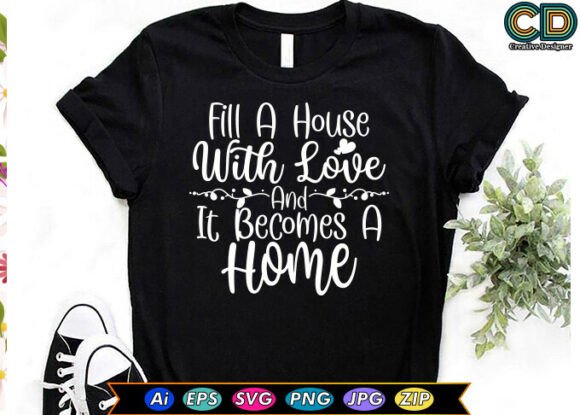
Fill a House with Love and It Becomes a Home
As a designer who’s stitched hundreds of custom pieces—from boutique baby blankets to Etsy best-selling tote bags—I opened Fill a House with Love and It Becomes a expecting warmth. What I got was something more grounded: a quiet, confident design that doesn’t shout, but settles in like a well-worn apron. It’s not flashy. It’s not trend-chasing. It’s the kind of embroidery file that earns repeat orders because it feels *true*—not just pretty.
I tested it first on a heavyweight organic cotton sweatshirt for a local nursery owner’s holiday gift set. The phrase is centered, softly curved, with gentle letter spacing and subtle weight variation—enough personality to avoid looking like default font, but clean enough to stitch crisply at 3.5" wide. No ornate flourishes. No tiny serifs begging to vanish in fill stitch. That simplicity? It’s intentional—and deeply practical.
Where This Design Lives Best (and Why)
Fill a House with Love and It Becomes a thrives where sincerity matters more than sparkle. Think:
- Embroidered pillow covers for new parents—soft script, no sharp angles, easy to read from across a nursery
- Canvas tote bags for small shops or wedding favors—clean lines hold up beautifully at 4–5" width, even on textured fabric
- Baby onesies and swaddle sets—moderate height and open letterforms prevent thread buildup and puckering on delicate knits
- Kitchen tea towels and aprons—balanced proportions mean it reads clearly whether hung vertically or folded
- Custom patches for community centers or family reunions—SVG and AI files make resizing and color-swapping effortless for batch production
It’s not built for high-contrast statement tees or streetwear drops. It’s built for the handmade product that gets tucked into a gift box with handwritten notes and dried lavender. That’s its strength—and its niche.
What Happens When You Stitch It (Real Talk)
On medium-weight cotton twill (think tote bag or apron), the design stitched cleanly with standard tear-away stabilizer. The curve of the phrase follows natural hoop movement—no abrupt directional shifts that cause thread breaks or tension hiccups. Letter spacing stays legible down to 2.75", which means it works comfortably in a 4"x4" hoop without compression tricks.
On stretchy jersey (tested on a lightweight crewneck), I added light cut-away stabilizer underneath and slowed my machine speed by 20%. Result? No distortion, no wobble—even in the lower loop of the “g” and the soft curve of the “a.” That resilience matters if you’re an Etsy seller juggling client requests across fabric types.
But here’s where attention is needed: on dark fabrics, the lighter-weight fill areas—especially inside letters like “o” and “e”—can look slightly translucent if your thread isn’t dense enough. A quick test stitch on black cotton duck confirmed that switching from 40wt to 30wt thread improved opacity without adding bulk. Also, avoid layering this directly over seams or darts—it’s not designed to conform to heavy contouring like a cap front would demand.
Design Assets That Actually Support Your Workflow
The included formats aren’t just checkmarks—they’re functional. The transparent PNG (4500×5400 @ 300 dpi) is perfect for printable mockups when pitching to boutique buyers or updating your Etsy listing visuals. The SVG and AI files let me adjust kerning for tighter fits on narrow items like wristlet pouches or child-sized caps. And the EPS? Lifesaver when prepping vector-based production sheets for multi-head embroidery machines.
That said—this is a graphics design, not a machine embroidery design out of the box. There’s no .dst, .pes, or .jef file listed. If you plan to use it for commercial embroidery, you’ll need to digitize it yourself or hire a digitizer. Don’t assume the AI or SVG will load directly into your embroidery software without conversion. Test that step early.
Customer Trust Starts With Clarity
I’ve watched customers pause mid-checkout when embroidery looks pixelated, unbalanced, or overly busy. Fill a House with Love and It Becomes a avoids that hesitation. Its rhythm feels hand-drawn but precise—like someone took real care. That impression translates directly to perceived value. On a $48 linen pillow cover, this design doesn’t compete with the material—it complements it. Buyers notice that. They feel it.
For craft business owners, that subtlety builds consistency. Use it across baby gifts, kitchen goods, and holiday bundles, and it becomes a quiet signature—not a logo, but a mood anchor. Customers start recognizing the gentle curve of the phrase before they read the words. That’s brand cohesion you can’t force with filters or fonts.
Practical Notes Before You Embroider
Before stitching your first Fill a House with Love and It Becomes a project:
- Run a test on scrap fabric matching your final substrate—especially if using textured weaves, fleece, or blends
- Check contrast between thread colors and base fabric in both natural and artificial light
- Review stitch density in tight curves; some digitizers overfill those areas, causing stiffness
- Confirm your hoop size accommodates the full width—some versions may extend beyond 4" depending on scaling
- Inspect small interior details (like counters in “e”, “a”, and “o”) at actual stitch size—what looks fine on screen may vanish in thread
- Test in grayscale mockups to verify readability on light and dark backgrounds
- Use appropriate stabilizer: tear-away for stable wovens, cut-away for knits, and fusible for lightweight silks or linens
- Verify licensing terms before selling finished items or reselling the digital files—this is critical for Etsy sellers and small shop owners
This isn’t just another T-Shirt Designs download. It’s a thoughtful, restrained piece of visual language—one that earns its place on heirloom-quality items, not fast-fashion tags. It won’t go viral on TikTok, but it will earn a spot on a shelf in someone’s home, stitched with care, gifted with meaning, and kept long after the trend fades.
If your work lives at the intersection of craft, heart, and quiet intention—Fill a House with Love and It Becomes a belongs in your design assets. Just remember: its power isn’t in volume. It’s in stillness. And in embroidery, stillness is often the hardest thing to get right.